

Live Bootlegs on Tape
THE COMPLETE HISTORY OF CASSETTE TAPES
Part 7 - Live Bootlegs on Tape
THE COMPLETE HISTORY OF CASSETTE TAPES, Part 7
In the U.S., the bootleg cassette trade had its own flea-market economy. One notable example came in 1990, when police raided a rock music swap meet in Buena Park, California, confiscating more than 10,000 illegal records, tapes, and related goods valued at roughly $100,000. Fifteen vendors were cited, and the seized material reportedly ranged from videos of recent Paul McCartney concerts to cassette recordings of decades-old Beatles performances.
The RIAA assisted in the investigation, calling it one of the largest bootleg seizures on the West Coast at the time.
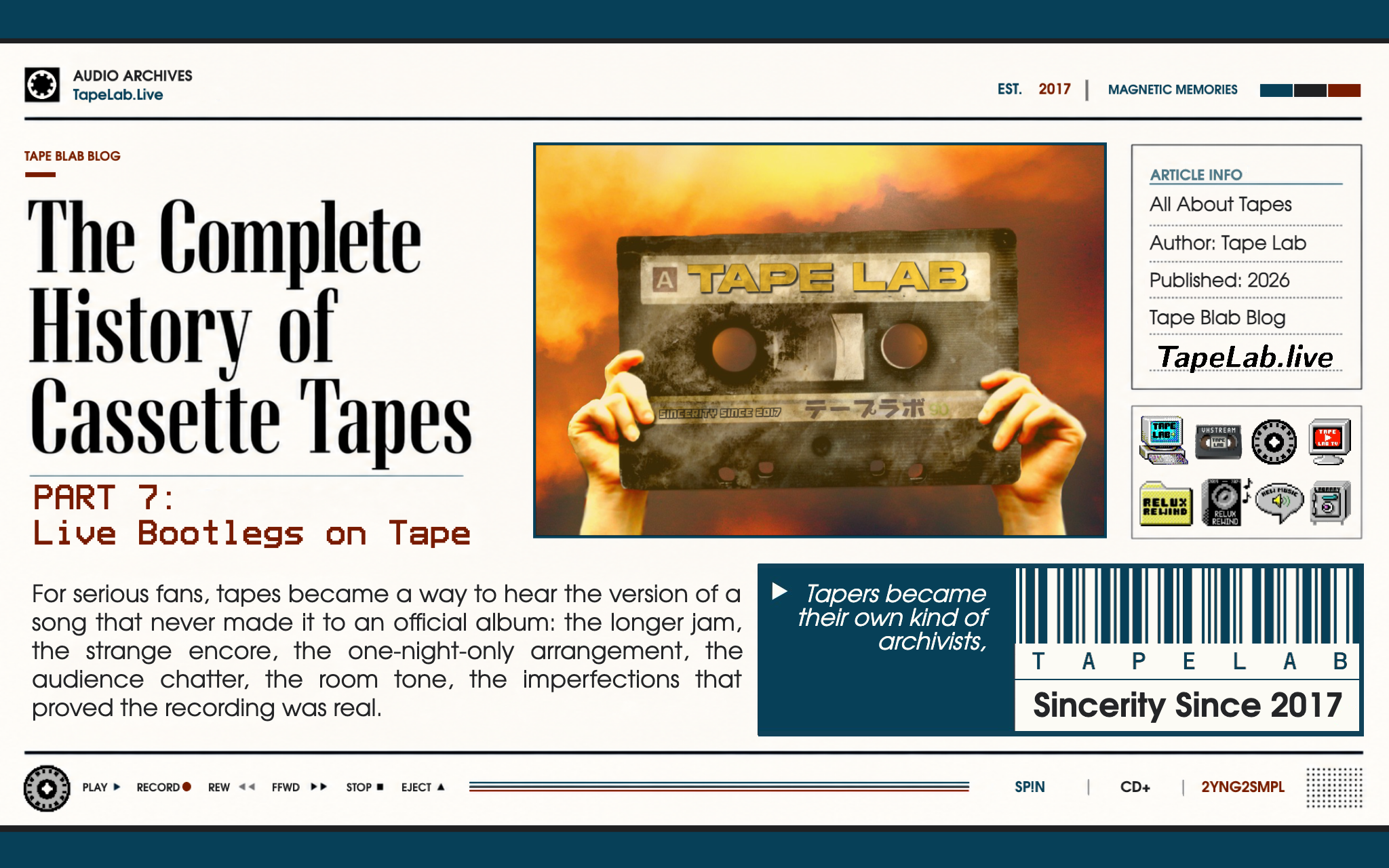
The bootleg cassette trade was not only about piracy; it also created an entire listener culture around access, rarity, and live performance. For serious fans, tapes became a way to hear the version of a song that never made it to an official album: the longer jam, the strange encore, the one-night-only arrangement, the audience chatter, the room tone, the imperfections that proved the recording was real.
Tapers became their own kind of archivists, documenting shows with handheld recorders, external microphones, and careful cassette labeling. In some scenes, a good live tape could travel farther than a record, moving through dorm rooms, parking lots, record fairs, mail-order trades, and fan networks long before the internet made live recordings instantly searchable.
The Grateful Dead Tapers turned this culture into something much larger and more legitimate. Unlike many major touring acts, the Dead famously allowed fans to record their concerts, eventually creating designated taper sections at shows. That decision helped make Deadheads one of the most important tape-trading communities in American music. Fans did not just collect Grateful Dead tapes; they studied them, compared setlists, ranked performances, copied shows for friends, and built enormous personal archives. The cassette became part of the band’s mythology: a physical record of a band that changed every night, and a social currency for a fanbase built around travel, sharing, and obsessive listening.
A tape could be contraband, a gift, a document, a fan object, or a secret doorway into a scene you could not otherwise access. From Grateful Dead parking lots to punk basements, metal shows, college radio circles, and flea-market tables, cassettes gave live music a second life—and helped fans build their own underground music libraries by hand.
A smaller but equally cassette-specific example happened the same year at the Lancaster Flea Market in California, where a vendor was arrested after authorities confiscated approximately 5,000 pirated cassette tapes. Detectives noted that the tapes looked professionally packaged, but lacked proper record company information or artist photos — classic signs of the gray-market tape trade.
For a more underground, live-recording angle, there’s also the San Diego bootleg taper scene. A San Diego Reader profile described one taper who recorded hundreds of concerts from the mid-1980s onward, first using high-bias cassettes and stereo microphones, later moving to DAT and digital formats. His recordings eventually fed overseas “live import” labels and U.S. distribution channels before federal anti-bootleg rules tightened in the mid-1990s.
For more information, see: A Day in the Life of the Digital Music Wars: The RIAA v. Diamond Multimedia
About The Complete History of Cassette Tapes
The Complete History of Cassette Tapes is Tape Lab’s 12-part guide to cassette tape history, from magnetic recording and the Walkman to mixtapes, bootlegs, tape duplication, underground labels, and the modern cassette revival.
