

Review: The OFFICIAL Tape Lab Lore Book
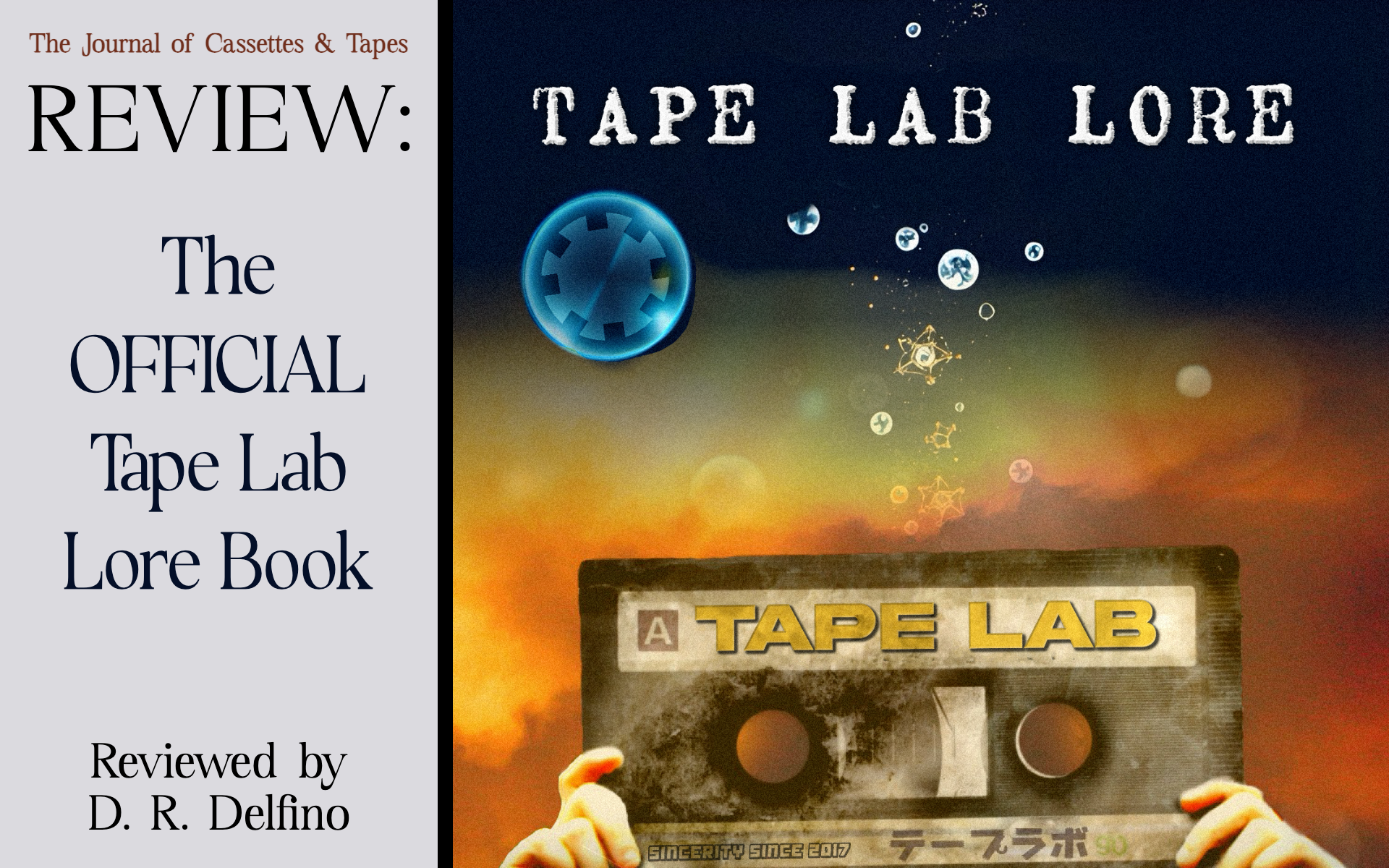
The Journal of Cassettes & Tapes Cover, Review of The OFFICIAL Tape Lab Lore Book by D. R. Delfino
Reviewed by D. R. Delfino for The Journal of Cassettes & Tapes
Appears in the Tape Blab Blog, April 20, 2026.While many artists clamor for engagement, Tape Lab offers an experience. Even with The Great Flattening now upon us, while an endlessly Streaming spray smoothes out the pesky cortex wrinkles, compressed audio blasting in our ears. Bluelight displays burnt into our retinas. The OFFICIAL Tape Lab Book of Lore is a decidedly analog alternative to feed-driven ephemera.
The OFFICIAL Tape Lab Book of Lore is available for $65.99 (Tape Lab Publishing, 2024)
It is a hefty text. The softcover weighs a mighty 4.18 pounds with over 700 full-color pages (including a full Appendix). For reference, it's bigger than anything Norton ever put out. Superficially, Tape Lab Lore documents and aggregates an expansive catalog of approximately 600 songs, plus exclusive art and supplementary materials folded in for fun.
Beyond what is on the page, the very materiality - that its body can be measured - testifies and bears witness to itself. Partly preposterous, at times pretentious, and always polemical.
“You can say anything when nobody is listening.”
Tape Lab, on the overlooked blessings of fanlessness.
As the “Official History of Tape Lab’s Origins and Lore” trudges through a vast (and self-imposed, there is absolutely no demand for this much detail) the survey clarifies its scope as an Unblinking Panoramic Whirlwind. Blessed and emboldened by an obviously light-handed, if-present-at-all editor, the narrator begins to recognize its own size with a sort of self-aggrandizing glee. Look on my data, ye Reader and despair.
Arguably, autobiography and memoir cannot be divorced from some level of mythmaking. So perhaps, Lore’s self-satisfaction should be considered as sincerity.
After all, there is always more Lore, after all.
Given the obvious aggrandizement of the title’s “OFFICIAL” moniker - preempting any potential confusion created from future UNofficial histories - this is an exercise in excess. A maximalist documentary object; exegetic, clumsy, desperately honest. What distinguishes the project most clearly is its archival seriousness. On its own terms, the book catalogs releases and provides exclusive unreleased bonuses, adding in stories and terroir, reflecting what the author calls, Tape Lab’s “Long Memory.”
That framework is central to the working thesis and is the best way to understand Tape Lab Lore as more than a souvenir, but as a work of counter-institutional scholarship: a vernacular encyclopedia assembled contemporaneously from within. In that respect, its abundant and unabridged footnoting, documentation, and robust bibliographic density, are not strictly ornamental.
The archive is the achievement; the method is the madness.
The central thesis of the Tape Lab Lore Book is that when nobody is listening, the artist can say anything. When nobody knows about it, nobody thinks they know about it. Strongly stated (with at times thin evidence): The purest forms of art exist without an audience.
Perhaps less salacious: art made on the margins is no less deserving of documentation than art made at the center.
Within the broader cultural tradition of American self-archiving, the Tape Lab Lore Book can be considered, in part, amateur ethnography. The overarching thesis, as it emerges from the project’s spatial materiality (printed on real paper!), is itself a reinforcement to the claim that Tape Lab is not disposable. Neither nostalgia nor ~cOnTeNt~ Tape Lab is an ongoing multimedia and multi-modal ecosystem spanning music, video, print, visual art, collaboration - The Lore Book is its Sonic Cosmology.
Considered within that context, the OFFICIALTape Lab Lore Book becomes a statement about documentation as performance: to catalog the work this thoroughly is itself an artistic act, one that collapses the distinction between archive and artwork.
Archival evidence, well-supported by primary source documents, reveals that the iconic tape-based collective known as TAPE LAB was founded in 2017 by lifelong friends in Efland, North Carolina. Like the band’s body of work at large, the Lore Book is decidedly “physical, flawed, sincere.”
The text is at its strongest when drawing upon North Carolina material, which is especially valuable in providing local grain texture for the Tape Lab Story that will surely fascinate fans and academics alike. Lore shows, convincingly, that Tape Lab’s origin story was both modest and exact: a Y-splitter wire, two 24-ounce Twisted Teas, a tape deck, and the distance between Graham and Efland.
Albeit anecdotal scholarship, the foundation matters because it prevents the project’s mythology from floating off into abstraction. The Tape Lab Lore Book is not an anonymous internet cloud of lo-fi signifiers and SEO-optimization. The opposite, refreshingly.
LORE is rooted in actual places, photographic proof, the loving descriptions afforded to Piedmont North Carolina, in the social texture of friendship, improvisation, and making do. From the text, a more complete narration of Tape Lab’s celebrated in-universe creative continuity, known somewhat cryptically as NEO-CARRBORO.
Like Faulkner’s Yoknapatawpha County or Jack Kirby’s New Gods - discovering the real-life inspiration for NEO-CARRBORO as a narrative space is a boundless exercise of joy - these sections do, at times, drag, likely due to Tape Lab’s controversial and contemptuous statements about editors and the Editorial Process at large.
Still, longform entries that crudely ape Gonzo Journalism help bolster Tape Lab’s iron-clad commitment to the "pre-nascent" North Carolina Underground Arts Collective. But, like the music, the text is at its best when it is communal rather than individual, process-driven rather than polished into sterility, and regional without becoming provincial.
Admirably and mercifully (despite a 4.18 lbs weight), the text balances scholarship with tone. Exhaustiveness always risks stiffness. A 700-page omnibus devoted to a single underground creative universe is destined, at points, to become dry. Yet in a project like this, dryness is not necessarily a defect; rather a visible cost of taking the material seriously enough to preserve it.
Omnibus projects, like the OFFICIAL Tape Lab Lore Book earn their keep by refusing the temptation to summarize away the evidence. Granular detail, however dense, is a calcified respect. The best sections intuitively understand this balance, preserving the record while still allowing personality and lived intimacy to break through. Crucial for a subject whose very ethos rests on the “conversion of friendship into art and art into NFTs.”
Indeed, the book is most compelling when it is least anxious about legitimacy and most willing to let sincerity carry the argument. Tape Lab’s public language repeatedly returns to friendship, collaboration, and chemistry, and that emphasis culminates in the book’s strongest emotional passages.
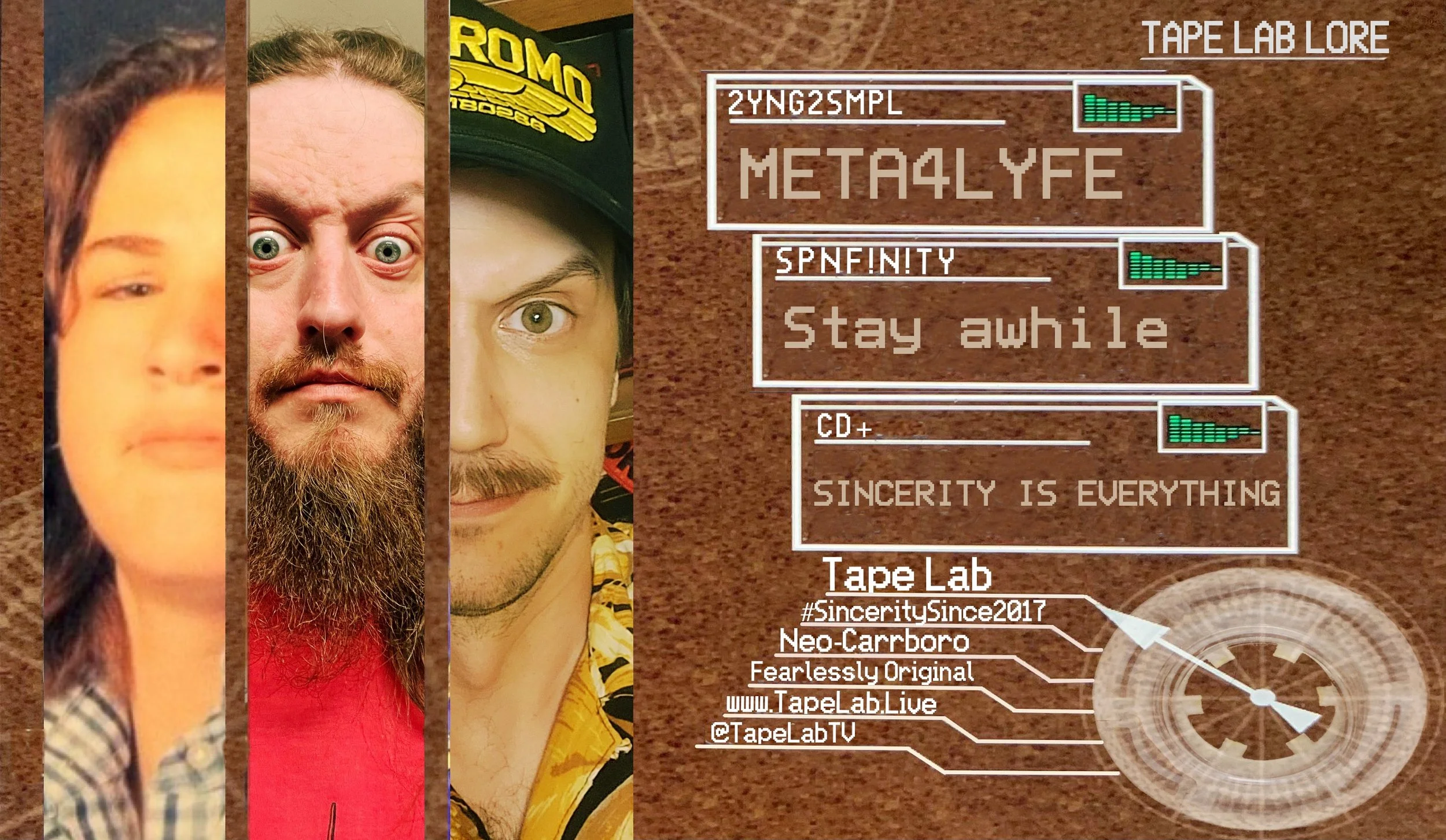
Tape Lab Lore Book (REVIEW) by D. R. Delfino for the Journal of Cassettes and Tapes (April 20, 2026)
Fat and happy, the true marrow of the text is a fine amalgam of releases, references, and ephemera; forged from repetition and disregard for reputation; co-conspirators returning the scene of the crime over and over again. In that sense, Tape Lab Lore argues that the true archive of unobserved and underground culture is relational before it is bibliographic. The materials, footnotes, and discographies matter tremendously, but they matter because they are traces of attachment, evidence that a group of friends considered their shared labor worth preserving.
The need to understand what date any 1 of 700+ tracks was originally recorded, released, remastered and remixed may be trivialized by naysayers or the disinterested, but, like all history, novelty is a result of extrapolation - what does this information tell us?
As a historical document, immortalized in the Library of Congress, The Tape Lab Lore Book tells us and generations of scholars and fans to come, that Tape Lab loved making art together, and the story of their friendship and art is a tale worth $65.99 (on sale from $95.99).
The physical presentation (and requisite cost) reinforces emotional and intellectual ambition. Is it an encyclopedia, a collector's archive box, or a coffee-table artifact?
If there is a larger scholarly value to Tape Lab Lore, it lies here: the book offers a model for how minor, local, self-made, and “ unsuccessful” (i.e., unmonetized) art can narrate itself with rigor and formal confidence. That may be its most interesting intervention into contemporary American arts discourse. Rather than pleading for relevance, Lore assumes the reigns of its own relevance and proceeds to document the case.
Even its humor—especially the essay about measuring success while unsuccessful—are central rather than incidental, hinting at acute subcultural self-knowledge. Awareness begets and permits acknowledgment of its own scale without reducing itself to irony. In that equipoise of seriousness and absurdity, of scholarship and self-awareness, Tape Lab Lore strikes its truest register.
Taken as a whole, Tape Lab Lore is a remarkable, undaunted act of self-historicization: occasionally overfull, filling its cup up to the brim and even above it. On occasion, delightfully dry. Its breadth is impressive and oppressive, borderline exegetical. For a self-published work of autobiography, this is far from fan fiction. The Tape Lab Lore Book’s documentary apparatus is unusually robust, and its thesis—about memory, materiality, friendship, and the necessity of preserving the cultural work done outside official institutions—is consistently sustained.
The Lore Book is equal parts companion and catalog, standing as evidence of existence and an argument for attention. Sweaty and desperate, sure, but spectacularly, painfully sincere.
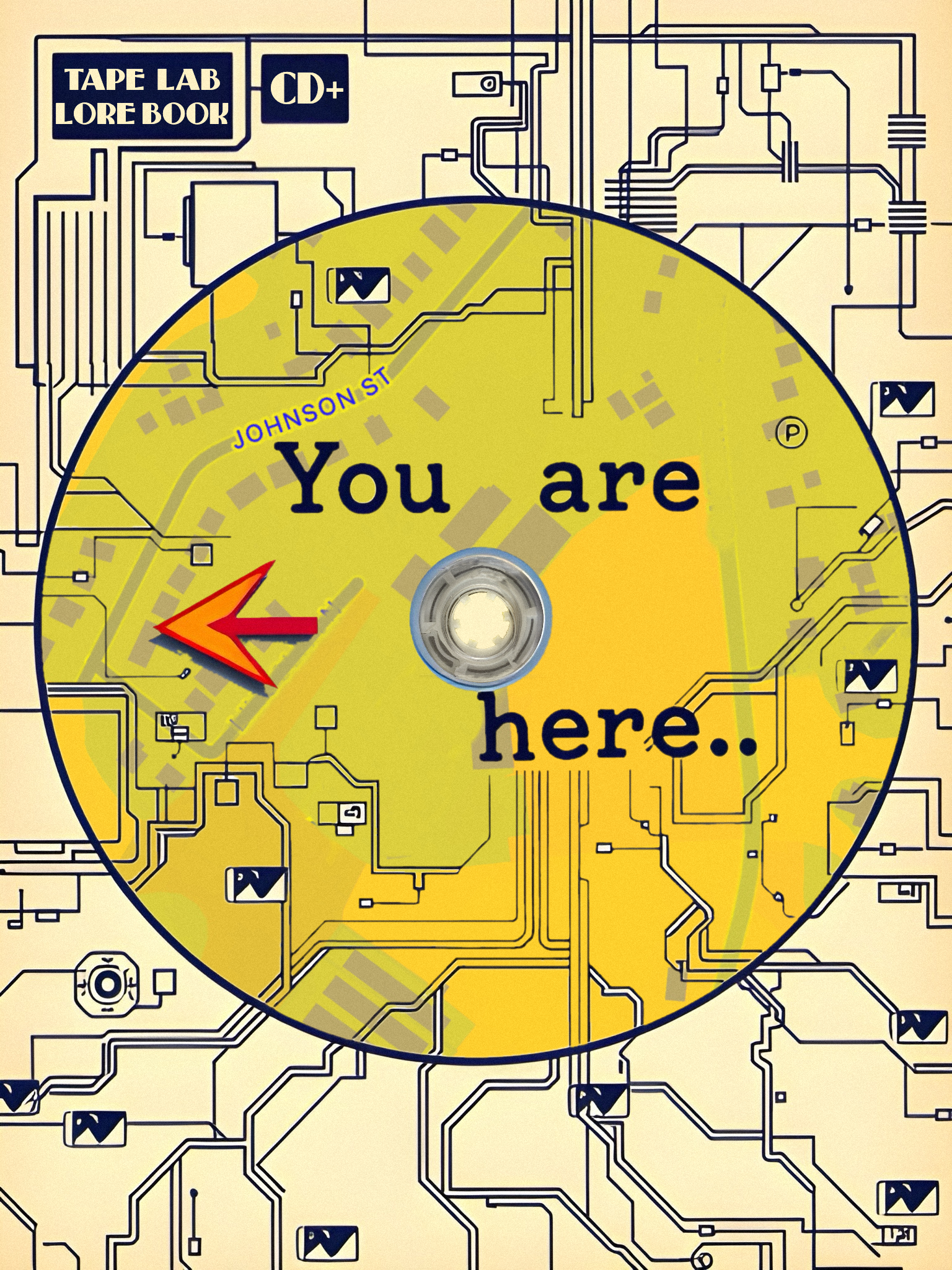
“You are here”
