

Mixing & Mastering on Cassette Release Playbook for 2026
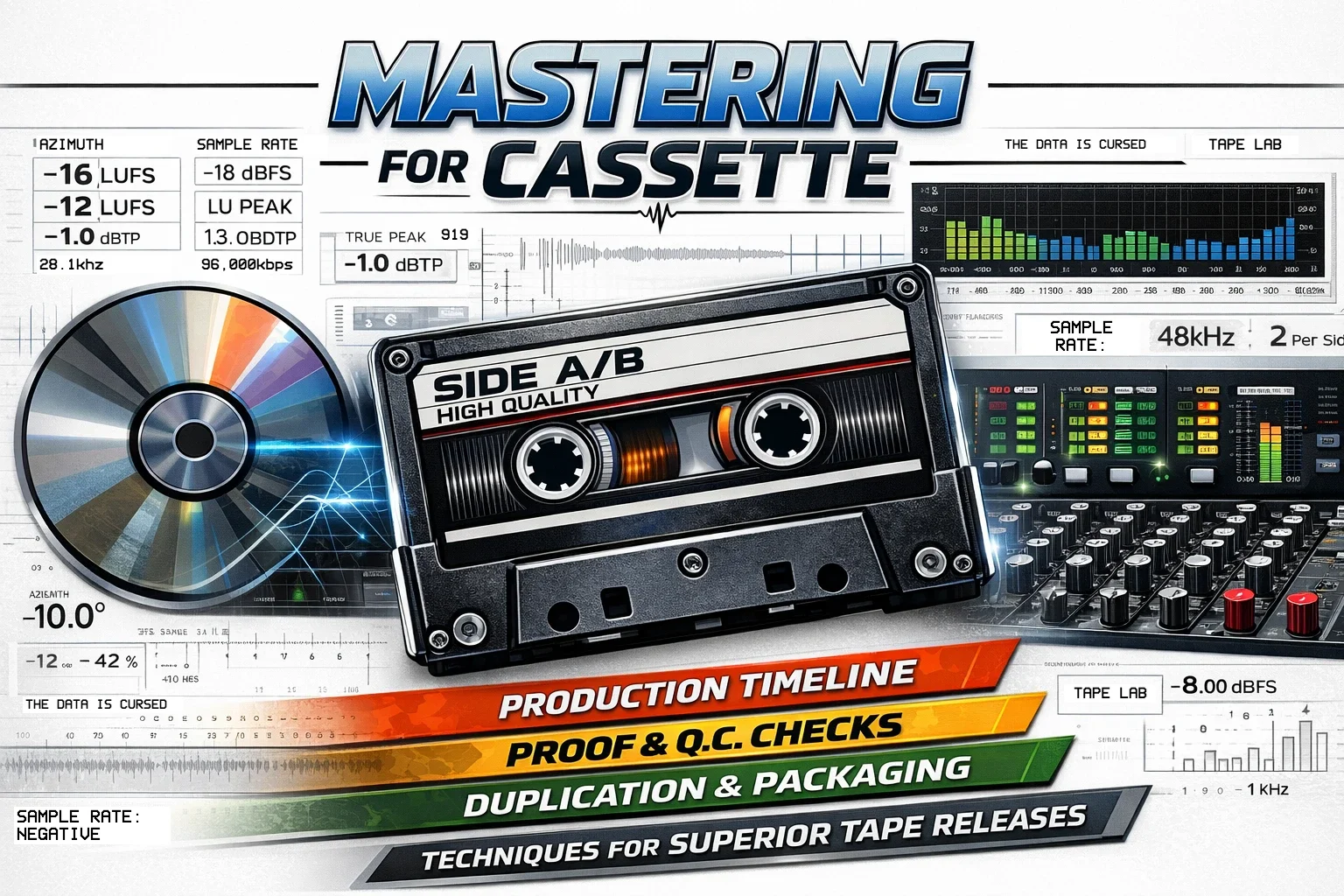
Cassette production is having a real resurgence in 2026, but making a tape release that actually sounds good still requires the right workflow. This guide breaks down how to master music for cassette, build reliable Side A and Side B files, evaluate proof cassettes, and work with duplication plants without wasting time or money.
From cassette-aware mastering and azimuth checks to shell quality, noise reduction, and packaging specs, this is a practical roadmap for independent artists, labels, and tape-focused releases. Whether you’re producing a short-run underground cassette or planning a larger duplication order, these are the key technical details, timeline expectations, and quality-control steps that help a cassette release sound intentional, stable, and worth keeping.
Mixing and mastering for Cassette tape are not easy, but nothing in life worth doing is easy. This Tape Lab Guide has everything you need to make your sound quality great in 2026.
TIMELINE
Week 0–1: mixes locked → cassette-aware mastering → render Side A/B WAVs → submit to plant → request proof.
Week 1–2: receive proof → QC on three decks → fix if needed → approve run → send final art.
Week 2–4: duplication + print → delivery → final QC → release shows/ship.
If a plant quotes you “rush,” ask what they rush (print only? shells only?).
Compact Cassette:
the 10-second diagram you’ll actually use
         [Supply Hub] -> (Guide) -> [Head Stack] -> (Capstan/Pinch) -> (Guide) -> [Takeup Hub]
                                               ↑
                              Pressure Pad ---┘ (many decks rely on this; good transports lift it)

Tracks (top view of tape passing head):
  ┌─────────────────────────── Side A ────────────────────────────┐
  |  [L A]  [R A]  (guard band)  [L B]  [R B]                     |
  └─────────────────────────── Side B ────────────────────────────┘
Flip the shell for Side B. Tape is 3.81 mm wide; speed = 1⅞ ips (4.76 cm/s).
Key takeaways: azimuth (head angle) rules your top end; duplex capstan transports rule stability. Five-screw shells beat welded. Store tails-out.
Mastering for Cassette
(step-by-step, with ranges that won’t embarrass you)
Pre-flight (before any tone shaping)
Headroom target (per side master): integrated –16 to –12 LUFS, true peak –1.0 dBFS or lower. Don’t chase streaming loudness; you’re feeding magnetic particles, not an algorithm.
Low-end hygiene: HPF non-music sub energy (rumble, stage thumps). Typical start 20–30 Hz, 12 dB/oct; more if program is long/hot.
De-ess to taste: wideband or split-band. Aim to tame “white-noise cymbals” on the eventual tape.
Core chain
(pick what the mix needs, in this order)
Surgical EQ (if needed): remove nasty resonances; leave vibe alone.
Tone EQ:
Gentle wide shelf: –0.5 to –2 dB @ 12–16 kHz if the mix is spiky.
Gentle wide bell: –1 to –3 dB @ 90–140 Hz if low end smears or side time is long.
Bus compression:1.2–2:1, attack 20–40 ms, release 100–200 ms, GR 1–3 dB. Purpose: glue, not loudness.
Saturation (subtle): tape-ish or transformer-ish plug at –6 to –10 dB drive; listen for weight without haze.
Dynamic EQ / de-harsh: narrow bands 2–4 kHz (vocals/guitars) and 6–10 kHz (cymbals) moving 0.5–2 dB.
Stereo control:
Keep sub-bass mostly mono (<100 Hz).
If widening, keep it subtle; cassette phase drift will clown you if it’s too wide.
Genre quick presets
(starting points, not law)
Punk/HC: faster release (80–120 ms), mild 120 Hz tuck (–1.5 dB), don’t over-de-ess—let it bite a little.
Lo-fi beats: low shelf –1 to –2 dB @ 40–60 Hz; gentle LPF @ 17–18 kHz; a touch of saturation for “thud.”
Synth/EBM: watch 2–3 kHz glare; small +0.5 to +1 dB @ 5 kHz for presence; keep kick mono tight.
Ambient/Drone: no brick; let dynamics breathe (DR 10–14). Consider pink noise floor between pieces to mask hiss jump cuts.
Test tones & slates
(baked into each side master)
At the start of Side A and Side B WAVs:
Slate voice: “Artist – Title – Side A – 2025-10-14 – no Dolby.” (~3 s)
1 kHz reference tone @ –18 dBFS, 20–30 s (level check)
10 kHz tone @ –20 dBFS, 10–15 s (azimuth check)
100 Hz tone @ –20 dBFS, 10–15 s (LF headroom)
Pink noise @ –24 dBFS, 10 s (broad sanity)
Then 0.5–1.0 s digital silence before Track 1. Repeat a 5–10 s tail of silence after last audio; then end file. (Plants will leader-tape the rest.)
If the plant prefers “program only,” keep a version without tones on hand. Many high-speed chains appreciate the tones; ask, but always keep tones in your reference proof so you can check their alignment.
Building Side A/B masters
(DAW recipes)
Sequence & spacing
Gaps: 0.5–2.0 s between tracks is normal; use consistent spacing unless you want a deliberate breath.
Side balance: keep A/B lengths within ±60–90 s. Long C90 sides need more conservative bass and level.
Crossfades: fine, but avoid super-quiet fades to digital black—hiss will “pop up.” Fading to a low-level room tone works nicer.
Export settings (safe defaults)
WAV PCM, 24-bit, sample rate = session rate (44.1 or 48 are standard; don’t SRC unless you must).
Dither only if you’re reducing bit-depth (you aren’t here).
File names:
Artist_Release_SideA_2025-10-14_NO-Dolby_24-44k.wav
Artist_Release_SideB_2025-10-14_NO-Dolby_24-44k.wav
Proof protocol
(don’t skip this)
What to request
One proof cassette made on the exact chain they’ll run (same stock, speed, NR settings).
Ask for their record reference fluxivity (often ~200 nWb/m) and whether they use Dolby B or HX Pro on record.
How to listen (three decks + one capture)
Good 3-head home deck (calibrated if possible) – detail, HF extension.
Average boombox/Walkman-ish portable – real-world midrange.
Truly trash portable – worst-case.
Capture pass back to DAW: line-out from best deck → interface @ 24-bit; compare to your digital master.
What to check
Azimuth: 10 kHz tone should be bright & centered; collapsing highs = crooked somewhere.
Dropouts/scrape flutter: listen for momentary HF dips or zippery shimmer.
Hiss floor: steady? any pumping implies mismatch with Dolby.
Left/Right balance: kick, snare, vocal centered?
Print-through: faint pre-echo before loud hits → acceptable; tails-out storage reduces audibility.
If it fails on two or more fronts, send notes with timecodes and what you heard. Be specific; they’ll respect that.
Duplication options & how to talk to plants
(so you sound like you know things)
The big toggles
Speed: Real-time (1×) = best; high-speed (8×–64×) = fine for most underground titles when the chain is maintained.
Stock: Type II (chrome/cobalt-doped) is the practical sweet spot now. Type I adds hiss/softness; Type IV (metal) is unicorn-priced.
Noise Reduction:
Record-side HX Pro: yes, please, if they have it.
Dolby B/C on record+play: only if they guarantee decode on playback (rare in the wild). Most labels run no Dolby for compatibility.
Shells: five-screw preferred; pressure pad quality matters. Ask for shell brand if you care (NAC, RTM-stocked, “generic”).
What you send (minimum viable package)
Side A/B WAVs (with or without tones as they specify) + checksum.
Track sheet with absolute timecodes (template below).
Spec sheet declaring NR policy, target side times, catalog #, and art notes.
Artwork using their dielines (always get the plant’s PDF; do not guess).
Shell print vector files (1- or 2-color spot, curves outlined, 300–600 dpi raster if you must).
J-card print PDF (riso/letterpress: talk ink coverage & paper weight early).
Download codes (if inserting) and how they’re packed.
Negotiables worth asking about
Leader color, pad color, shell color/window, pad print vs label, serial stamping, and if they’ll batch ID the run on the hub sticker.
Packaging quick reality
J-cards: designs vary by plant. Use their dieline. Keep type ≥6 pt, high contrast on spine, and avoid full-bleed super-dark solids with riso/letterpress (offset risk).
Shell print: 1-color is safest. If 2-color, allow 0.5–1 mm registration tolerance; avoid micro text.
Barcodes: UPC-A or EAN-13, black on white, leave a quiet zone. Place on J-card back, not the spine. If you don’t need retail, skip it.
Storage, shipping, and handling
Store: upright, cool (≈18–22 °C), 40–55% RH, tails-out.
Ship: avoid heat; don’t leave in cars. Use bubble wrap around whole cartons, not loose tapes.
Care card: include a tiny care blurb in the J-card: “store cool/dry, play occasionally, don’t leave in the sun.”
Templates
(copy/paste and fill)
Plant Spec Sheet (one page)
PROJECT:   Artist – Title  |  Catalog #: TAPE-00X  |  Date: YYYY-MM-DD

AUDIO
- Side A Master: Artist_Title_SideA_24-44k_NO-Dolby.wav
  Length (mm:ss): __:__
- Side B Master: Artist_Title_SideB_24-44k_NO-Dolby.wav
  Length (mm:ss): __:__
- Tones Included: [ ] Yes (1k @ -18, 10k @ -20, 100Hz @ -20, Pink @ -24)  [ ] No
- Noise Reduction on Record: [ ] None  [ ] Dolby B  [ ] Dolby C  [ ] HX Pro (record-side only)
- Reference Level (if applicable): [ ] 200 nWb/m  [ ] Other: __________

DUPLICATION
- Speed: [ ] 1×  [ ] High-speed (plant standard)
- Stock: [ ] Type II (preferred)  [ ] Type I  [ ] Other: _________
- Shell: Color _______  Window [ ] yes [ ] no  Screws [ ] 5  [ ] welded  Pressure pad: standard
- Leader/Trailer: [ ] Clear  [ ] Color: ______  Splice: [ ] standard [ ] visible

PRINT
- Shell Print: [ ] 1-color  [ ] 2-color  Colors: _____________  File: shell_print.pdf
- J-card Print: [ ] CMYK  [ ] Spot / Riso  Paper: _______  File: jcard_print.pdf
- Labels (if any): File: _________
- Barcodes: [ ] yes (UPC/EAN provided)  [ ] no

PACKING
- Norelco cases: [ ] clear [ ] black [ ] none (bulk)
- Download codes inserted: [ ] yes (Bandcamp cards) [ ] no
- Batch ID / Hub sticker: [ ] yes [ ] no

CONTACT & SHIPPING
- Contact: Name / Email / Phone
- Ship To: Address
- Notes: (anything weird they should know)
Track Sheet (absolute timecodes)
RELEASE: Artist – Title   |   SIDE: [A/B]   |   Date: YYYY-MM-DD
Start times are from start of program (after tones). Keep mm:ss precise.

# | Start  | End    | Len   | Title
1 | 00:00  | 03:12  | 03:12 | Track Name
2 | 03:12  | 06:45  | 03:33 | Track Name
3 | 06:45  | 10:20  | 03:35 | Track Name
- Total side time: __:__
Notes: (crossfades, “no gap after 2→3”, etc.)
QC Checklist (use for proof & final run)
Cassette QC – Artist/Title – Date: _______ – Copy #: __/__
Decks used: (1) Good 3-head: ______  (2) Boombox: ______  (3) Trash portable: ______

GLOBAL
[ ] Packaging correct (spine text, shell color/print)
[ ] Side labels vs audio (A/B not swapped)
[ ] No obvious shell rattle / binding

AUDIO – SIDE A
[ ] Levels consistent vs ref master
[ ] 1 kHz tone stable; no warble
[ ] 10 kHz tone bright/centered (azimuth okay)
[ ] No audible dropouts (note times)
[ ] Hiss steady; no pumping/breathing
[ ] Track starts/ends match track sheet
Notes:

AUDIO – SIDE B
(Repeat items above)
Notes:

ISSUES / ACTIONS
- Timecode 03:47 A: minor dropout (1–2 frames) – acceptable? [ ] yes [ ] no
- Timecode __:__ B: azimuth dull on boombox only – investigate deck? [ ] yes [ ] no

SIGN-OFF
Approved for production: [ ] yes  [ ] no   |  Name/Initials: ______
Budget / Break-even (fill the blanks)
Unit cost from plant (all-in): $____
Order qty: ______
Shipping/fees per unit (avg): $____
Total landed cost = (unit cost + ship/fees) = $____

Planned retail price: $____
Per-unit gross margin = retail – landed = $____
Break-even units = total project cost ÷ per-unit margin = ____ units
Reserve ____ copies for promo (subtract from sellable inventory).
Email to the plant (steal this)
Subject: [PO + Catalog#] Artist – Title (Type II, no Dolby, proof request)

Hi [Rep],

Attaching Side A/B WAVs (24/44.1), spec sheet, track sheet, and artwork using your dielines.
Please duplicate on Type II stock, no Dolby, HX Pro on record if available. Five-screw shells.

Requesting:
• One proof cassette made on the exact production chain
• Confirm record ref level (ideally ~200 nWb/m)
• Estimated ship date for 100 + 25 holdback

Notes:
• Slate/tones are included at head of each side for QC; final run can omit if you prefer.
• J-card is 1-color riso; paper stock as discussed.

Thanks,
[Name] / [Label] / [Phone]
Artwork guidance
(short, to save you tears later)
Use the plant’s dieline. Always. Every time.
Spine: keep high contrast and ≥6 pt, avoid hairline serifs.
Black solids (riso/letterpress): keep coverage <50–60% overall or expect offsetting.
Shell art: outline fonts, solid fills > lines; avoid micro-details and fine halftones.
Troubleshooting (fast fixes that actually work)
Dull highs on proof
First, check your deck: clean heads, demag, confirm azimuth using their 10 kHz tone. If the good deck is bright but the boombox is dull, that’s life. If all decks are dull, send a note: “Proof sounds rolled off vs reference; please verify azimuth on duplication chain.”
Audible hiss in quiet parts
That’s tape. But you can print low-level texture or room tone under long silences to mask “hiss jump cuts.” Or re-sequence so the quiet moments land where they feel intentional.
Dropouts / scrape flutter
Usually shell or slit quality. Send timecodes. Ask for a new proof. If it’s isolated, it may be the one proof shell—request replacement and proceed.
Bass mud / kick smear
Lower program level 1–2 dB on that side, and/or carve –1 to –3 dB at 90–120 Hz with a wide bell. Very long sides need calmer bass.
Dolby weirdness (pumping, HF ducking)
If you didn’t spec Dolby but they used it on record, politely ask them to redo no Dolby (HX Pro only). If you did spec Dolby B for both sides, label the J-card so listeners can engage B.
Side-by-side DAW workflows
(quick recipes)
REAPER
Put each album mix on its own track.
Create two regions: Side A & Side B.
Prepend a “Tones” item to each region (rendered from a tone generator track).
Use Region Render Matrix to export two WAVs in one pass.
Dither off (24-bit). Name via wildcards: $region_$date_$samplerate-$bitdepth.wav.
Ableton Live
New project per side.
Track 1: program sequence. Track 2: tone clips.
Consolidate → Export Master, 24-bit, no dither, normalize off.
Pro Tools
Assemble playlist per side on a stereo track.
Print to a new audio track via bus (tones at head), then Export Clips as Files at source rate/24-bit.
What to ask the plant on day one
(copy/paste into an email)
What stock do you currently have for Type II? (brand/lot)
Do you record with HX Pro? Any Dolby on record?
What reference level do you align to (nWb/m)?
Do you prefer program-only WAVs, or are head tones helpful for QC?
Can you provide a proof on the production chain?
Lead time and any blackout dates (holidays, maintenance).
Any recent issues with 1× vs high-speed we should know about?
Release & Promo
(the unglamorous part that moves units)
Staggered reveal: announce run size & colors, share a 60–90 s cassette-captured clip (yes, record the proof playback) so people hear the medium.
Point of sale: shows first (bundle with pin/patch), then Bandcamp, then local shops.
Quantity: start at 50–150. Sell out? Congrats, do another 50.
Price sanity: keep it impulse-friendly; you’re building a scene, not scalpers.
One-page “Do This, Not That”
Do: Type II, no Dolby, HX Pro if available, proof on chain, five-screw shells, tones at head, QC on three decks, tails-out storage.
Don’t: C120s, welded shells (if avoidable), brickwall to death, mystery gaps, unlabelled NR, guessing dielines, skipping proofs.
Appendices
(nerd-ier bits)
A. Reference tones: why those levels?
–18 dBFS 1 kHz roughly sits where many plants calibrate their record chain, giving them headroom to bias without nuking your first chorus.
10 kHz @ –20 dBFS reveals azimuth without instantly saturating HF.
100 Hz @ –20 dBFS exposes LF headroom/bias issues that smear kicks.
B. Side time & headroom rule-of-thumb
Longer side = lower safe level. If you push a C90 like a C30, you’ll get veiling and more print-through. When in doubt, back off 1–2 dB and tighten lows.
C. Cassette-aware arranging (free wins)
Keep critical detail out of whisper-quiet tails.
Use midrange movement to mask hiss.
If you love crystalline “air,” print a digital bonus with the tape.
Tiny J-card copy block
(fill-in, minimal cringe)
Artist – Title  |  TAPE-00X  |  2025 Tape Lab
Recorded ______  |  Mixed/Mastered ______
Duped on Type II, no Dolby. Store cool & dry. tails-out.
Download: yoursite.bandcamp.com/____
About Tape Lab
Tape Lab is a world leader in tape-based media and culture, with over 10 years of experience creating, documenting, and championing cassette-centered art, music, and ideas. With more than 500 internationally distributed releases, Tape Lab has built a vast catalog that spans music, video, publishing, and experimental media. New music videos, releases, and publications are added all the time, alongside DIY guides designed to help tape lovers create, collect, preserve, and better understand cassette culture. Rooted in independent spirit and driven by deep format knowledge, Tape Lab continues to push tape forward as both a medium and a movement.
